New to Audio? Here Are the Terms You Must Know
Audio equipment becomes easier to choose when its vocabulary stops sounding like a secret code. A product page might mention impedance, headroom and frequency response in the same paragraph, even though each describes a different part of the system. The terms below provide a practical starting point for reading manuals, asking better questions and recognising when two specifications cannot be compared directly. None of them, on its own, proves that a system will sound good.
1. Frequency and frequency response
Frequency describes how often a sound wave repeats, and listeners perceive changes in frequency broadly as changes in pitch. Frequency response describes how a device behaves across a range of frequencies under stated test conditions. It is not a single guarantee of sound quality. Placement, room acoustics and the recording itself all affect what a listener hears. When comparing response charts, check how and where measurements were taken before treating a wider range as a better result.
2. Decibels and sound pressure level
A decibel expresses a ratio on a logarithmic scale; its meaning depends on what is being measured and the reference used. Sound pressure level describes acoustic level at a measurement position. An amplifier’s electrical gain and a loudspeaker’s sound pressure are not interchangeable figures. Distance, room reflections and speaker direction can change a reading. For everyday use, choose comfortable listening levels and avoid assuming that a higher number means a more useful system. Someone comparing professional loudspeakers will often encounter maximum-level figures in product literature. Those figures are useful only when the measurement methods and intended listening distance are understood. Ask for the conditions behind a number before comparing cabinets.
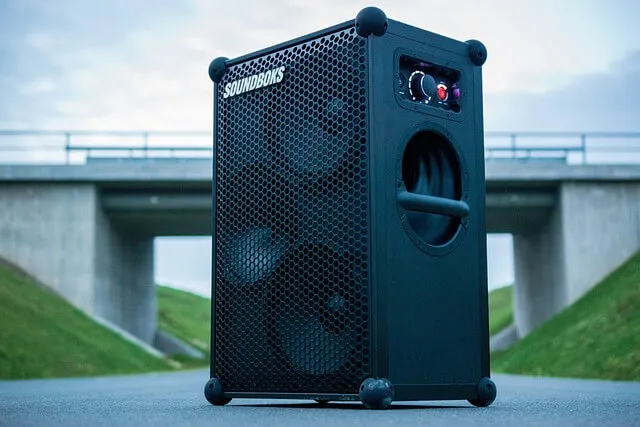
Image Source: Pixabay
3. Impedance and power
Impedance describes how an electrical circuit opposes an alternating signal; loudspeakers present loads that vary with frequency. An amplifier must be suitable for the load it drives. A power rating also needs context, including test conditions and whether it refers to continuous operation or a short peak. Anyone assembling passive speakers with professional loudspeakers should consult the manufacturers’ compatibility guidance rather than pairing components solely because their advertised wattage figures look similar.
4. Gain, headroom and clipping
Gain describes a change in signal level. Headroom is the margin available for peaks before a stage reaches its operating limit. Clipping occurs when a signal exceeds what a stage can reproduce cleanly, creating unwanted distortion. These ideas connect during setup: excessive input level can cause trouble even when the final volume control is low. Set levels through the signal path deliberately and use meters as guides, supported by careful listening.
5. Equalisation and crossover
Equalisation changes the balance of selected frequency ranges. It can help manage a particular tonal problem, but large boosts may create another one. A crossover divides the audio signal into bands intended for different drivers or speaker cabinets. Its settings need to suit the equipment connected. Equalisation is not a repair for incorrect wiring, poor speaker placement or a crossover that sends unsuitable frequencies to a driver.
6. Latency and phase
Latency is the time taken for a signal to pass through part of a system, and it can matter during live monitoring or when several devices work together. Phase describes the relationship between repeating signals. Timing and phase differences can cause sounds from multiple speakers to reinforce or reduce one another at particular locations. These effects are context dependent, so a single adjustment that helps one seat may not improve the entire room.
A useful next step is to read one equipment manual while tracing the real signal path, from source to the sound arriving at the listener. Match each term to a control, connection or measurement and note which specifications need additional context. Vocabulary becomes valuable when it helps someone ask a precise question, choose compatible equipment or identify the cause of a problem without guessing. When reading about professional loudspeakers, identify whether a stated figure refers to the cabinet, its amplifier or the entire installed system. That simple distinction prevents many misleading comparisons.